What will happen to FIFA World Cup viewership numbers after the exits of hosts USA, Mexico, and Canada?
Published about 2 months ago • 4 min read
Welcome back to Bucholtz Sports Media! This analysis post is free for everyone thanks to our premium subscribers, who you can join here for just $5 a month. Now, on to the piece...
Where will World Cup viewership go following the hosts' exits?
The USMNT's Chris Richards after their loss to Belgium Monday. (Fox Sports on YouTube.)
The 2026 FIFA World Cup has produced incredible viewership thus far in both the U.S. and Canada. On the U.S. front, Fox has set countless records with their English-language coverage, while NBC Sports' Spanish-language coverage across Telemundo and Peacock has also set records. In Canada, Bell Media's coverage across TSN and CTV has pulled incredible numbers as well. But many of those numbers have been driven by matches involving the three host countries: the U.S., Mexico, and Canada. And all three of those countries crashed out this week in the Round of 16, with Canada losing to Morocco Saturday, Mexico coming up short against England Sunday, and the U.S. losing to Belgium Monday. What will that mean for the tournament's ratings going forward?
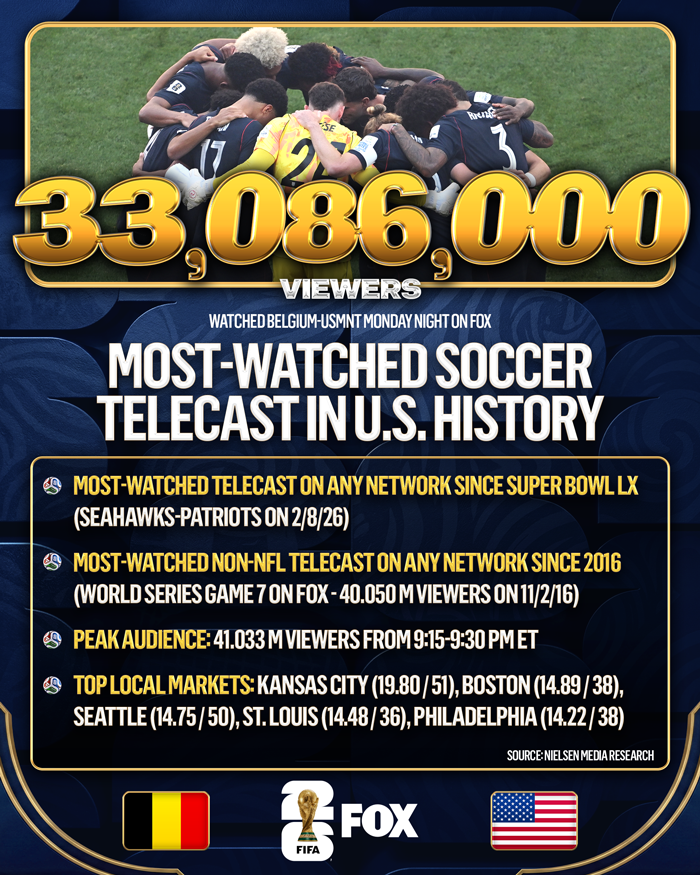
First, it's instructive to take a quick look at just how good that viewership has been, and how much of it has involved those host teams. Here are a few examples from the Round of 16 matches, but there was good viewership well before that as well:
It seems safe to say we probably won't see exactly those viewership heights for the remaining quarterfinal matches. The semifinals may not get that high either, but they'll be closer, and they might even pass some of this with the right matchups. And the final itself is quite likely to set a World Cup record, with a favorable time zone and with notable changes in Nielsen's measurement (including out-of-home and Big Data+Panel) since the last World Cup (2022 in Qatar). And that previous World Cup also saw the U.S. exit in the Round of 16 and saw Canada and Mexico fail to make it out of their groups, so it's not like it had a better performance from these countries. Thus, the event-to-event setup teamwise is quite comparable from this point forward, and this World Cup is likely to do much better given the time zone, given the measurement changes, and given the ancillary excitement from matches being held in Canada, the U.S., and Mexico (outside of the soccer and sports circles where the World Cup is always a big deal, it feels like there's a lot more coverage of and buzz about this World Cup than the last one, and part of that's thanks to it being held here).
But the point remains that having all three of those host countries bow out at this stage is unfortunate for these broadcasters. If even one of them had managed to make it to at least the quarterfinals, that would have been a significant coup. (Well, the magnitude of the coup would depend on the audience you're talking about: Canada advancing would have been big for Bell, while either the U.S. or Mexico advancing would have been great for both Fox and Telemundo.) And it would have meant further and further record-shattering; to put things in perspective, the 44 million viewers for Mexico-England and 42 million for U.S.-Belgium (both of those are U.S. viewership numbers, with English-language and Spanish-language viewership added together, and with Adobe Analytics data incorporated for Telemundo's streaming via Peacock) were ahead of the NFL's most recent divisional round games (an average of 39.2 million viewers), and not far behind its conference championship games, which averaged 47.4 million viewers. Considering that these matches were in the Round of 16, with three more matches for the winner if they make it all the way, they're equivalent to the NFL wild-card round in terms of the stage of the tournament. So beating the divisional round (quarterfinals equivalent) and coming close to the conference finals (semifinals equivalent) is very good indeed, and suggests a deeper run for the U.S. or Mexico might have set non-Super Bowl records. (And a run all the way to the final, improbable as it might be for those countries at this point in time, might have been in the conversation with the Super Bowl in terms of viewership.)
Without those countries, all of these broadcasters are still likely to be fine. They've been pulling much smaller numbers for matches not involving the hosts, but those numbers have still frequently been records when compared to similar games. There's still tons of buzz around this tournament, and there are still fascinating players and teams involved. But the hosts' exit at this point does make it seem less likely that we'll see really earth-shattering viewership going forward. It will be interesting to track that, though, and to see how well these broadcasters can do with the World Cup after the exits of the home sides.
Bucholtz Sports Media 4123 S Prieur St, New Orleans, LA 70125 Unsubscribe · Preferences