Massive College Football Playoff National Championship numbers don't inherently prove format greatness
Published 9 months ago • 4 min read
Welcome back to Bucholtz Sports Media! This post is exclusively for our premium subscribers; you can join them here for $5 a month or $50 a year. Now, on to today's topic...
CFP National Championship TV numbers alone don't prove the playoff should eternally be 12 teams
A graphic of Indiana Hoosiers players celebrating their 2025-26 college football national title. (Big Ten Football on YouTube.)
An important mantra in many fields of analysis is that "Correlation does not imply causation." While there are many upsides to humans' focus on stories (see Pan narrans), it's important to make sure those stories are accurate. And, frequently, multiple things can be true at the same time. That's important to keep in mind with some of the narratives coming out of the College Football Playoff National Championship Game.
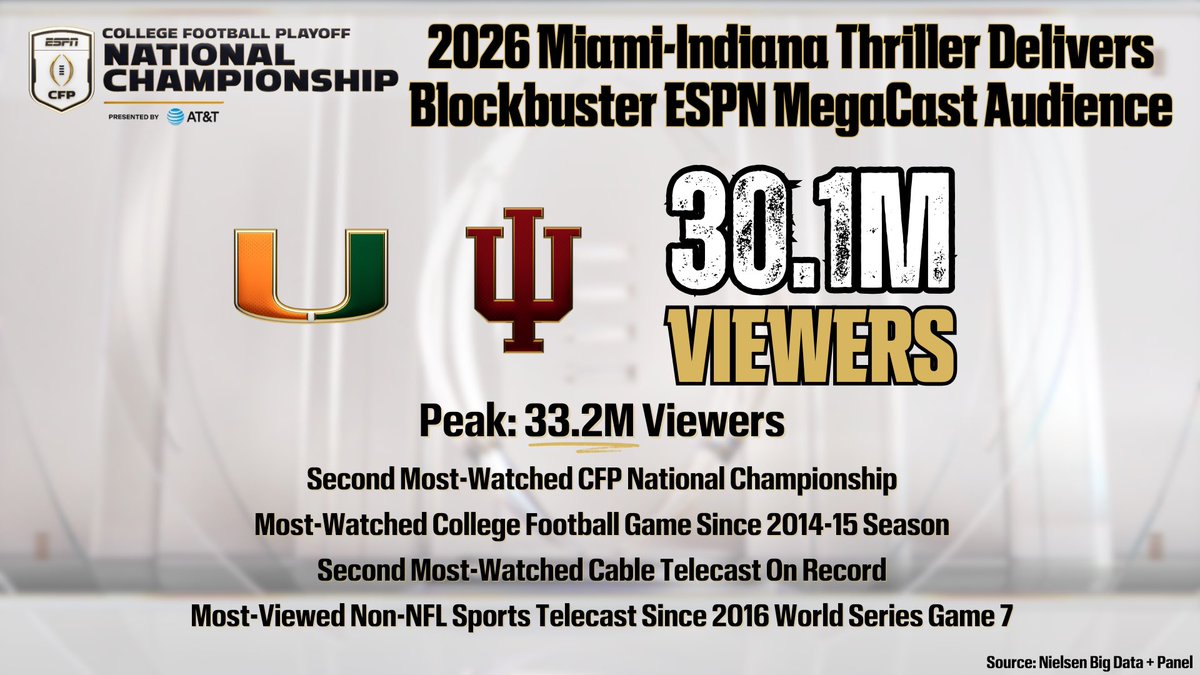
By any metric, the spectacular average of 30.1 million viewers across ESPN networks for Indiana's 27-21 win over Miami in that title game Monday (the most for any college football game since the inaugural four-team CFP title game in 2014-15, where Ohio State beat Oregon 42-20), was excellent business news for ESPN and for college football as a whole. And the notes ESPN put out on this are valid. They had a lot to celebrate:
But those numbers should be kept in context, as they don't necessarily prove the sport's current postseason is its best. Yes, this was a piece of evidence that this particular unusual final matchup (the Big Ten champion and No. 1 playoff seed Hoosiers were not outsiders from the start of the playoff, but they were the team with the longest preseason odds in since-2001 tracking and had a FBS record 713 losses when head coach Curt Cignetti took over in December 2023*, while the No. 10 playoff seed Hurricanes barely made the CFP field) and its suggestion of some widening at the top of the sport worked just fine from a business perspective. That runs counter to the narrative that people will only watch "blue bloods" (the concept of established CFB powerhouses, not the long-running Tom Selleck CBS show). And yes, this viewership also spoke in favor of this particular 12-team CFP format's ability to balance rewarding season-long success like Indiana's while still providing room for unexpected playoff runs like Miami's. But some of the claims making their way around the media world on these numbers feel over-the-top; they're not solely because this was a 12-team playoff, and they don't necessarily prove that a 12-team playoff should be eternally carved in stone.
Indeed, ratings overall stand out as a key area to remember the difference between correlation and causation. There are so many factors involved in any eventual ratings number, from the participating teams through where and when the telecast airs to even how viewership is tracked by Nielsen (which, as regularly noted, underwent a major change last January with a full shift to Big Data+Panel, which has particularly boosted many sports events' numbers). And one of the most critical for sports (although it's frequently underdiscussed, perhaps due to it being harder to predict than other factors) is how excitingand close a given game is.
The average viewership numbers that tend to be the most-discussed elements around a given telecast often drop dramatically if people tune out partway through a game that looks like a foregone conclusion. They conversely rise if a game is so close and exciting that it generates more social media/app alert conversation, drawing people to tune in. And, considering the remarkable back-and-forth this game saw and the way the CFP semifinals set playoff-record lows (especially with one of those games, Indiana's 56-22 thumping of Oregon in the Peach Bowl, being a blowout), there's a decent case that these ratings came more from this being an exceptional game than from anything structural around a 12-team playoff or about this particular matchup.
None of that is to say that a 12-team playoff is the wrong answer, or one that college football won't stick with. Many are pushing for further expansion, but while that would have some benefits (in particular, letting currently-excluded teams like this year's Notre Dame squad prove their argument on the field rather than with politicking, while not diminishing the Group of Six access for the likes of Tulane and James Madison), a lot of the current expansion conversations seem mostly about guaranteeing more Big Ten and SEC schools in the field. That would go against the hopeful room-at-the-top message from how this postseason played out, and more importantly from a business perspective, it might actually devalue the regular season to a more significant degree. (People shouted about that with the shift from the BCS to the four-team CFP, and again with the shift to a 12-team CFP, but the regular season clearly still mattered in both giving the Hoosiers the top seed here and in determining which on-the-margin teams made it.)
The point here is not to argue for further playoff expansion. That deserves its own on-the-merits analysis of pros and cons. The point is that there's a lot to suggest that this game's viewership success was largely about its inherent on-field quality more than the specific matchup or the particular 12-team format. This game might have drawn just as well as a two-team BCS championship or a four-team CFP national title game. The 12-team format seems better than either of those from this perspective, but that's about overall consequences for the sport (including access for more teams), and, from a business standpoint, increased inventory of meaningful postseason games. Drawing big ratings for a thrilling title game is not really an endorsement of any given system; if it was, the 35.6 million viewer average (5.5 million higher than this!) for the 2006 USC-Texas Rose Bowl would have suggested that the BCS was a perfect approach that deserved to stay. From this corner, this game, its quality, and its ratings can be celebrated without that necessarily indicating much about the system that produced that game.
*Cignetti has gone 27-2 in three seasons with Indiana, including this game. Northwestern overtook the Hoosiers as the FBS all-time loss leader in November.
Bucholtz Sports Media 4123 S Prieur St, New Orleans, LA 70125 Unsubscribe · Preferences