Tony Romo's CBS exit marks the end (for now) of an important broadcasting run
Published about 4 hours ago • 9 min read
Welcome back to Bucholtz Sports Media! This post is free for everyone thanks to our premium subscribers, who you can join here. Now, on to the piece...
Tony Romo's broadcasting impact should be remembered amidst his muted departure from CBS
Tony Romo at a CBS photo shoot in 2018. (John Paul Filo/CBS.)
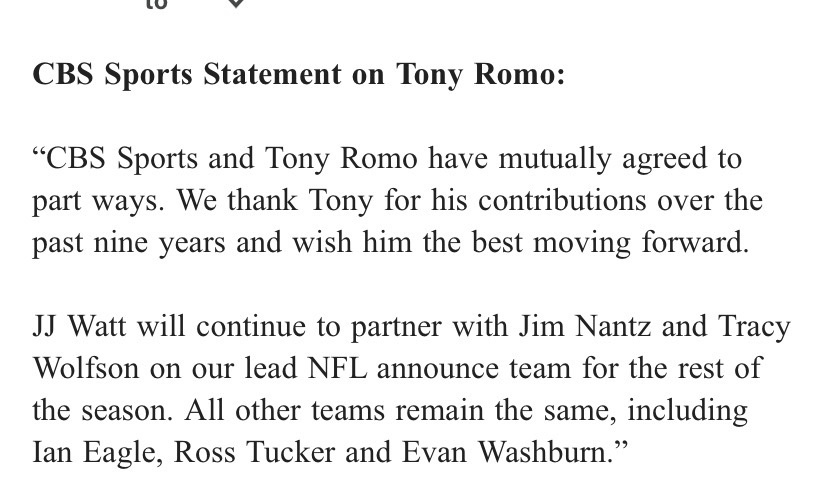
Friday's news that CBS and Tony Romo are parting ways is far from unexpected. Romo had been on leave from the network since July in the wake of an operating while intoxicated charge he received in Wisconsin, which he pled no contest to last month. The big question as the NFL season started was how well replacement J.J. Watt would do in his promotion to CBS' top NFL booth alongside Jim Nantz, but that move seems to have worked out fine thus far, and there was discussion about CBS and Romo finding an exit even before Watt's first game. And now, that's come to pass. Here's the CBS Sports statement, via Richard Deitsch on X:
And here's a statement from Romo his team sent over:
"I’m proud of what I accomplished at CBS Sports over the last nine years. I approached my role as a game analyst the way I’ve approached everything in my life–with a desire to win and be the best that I can be. I'm going to use this time to take a break, something I've never done before, and focus on my health and my family before moving on to my next opportunity. I am grateful for my time with CBS Sports and for the continued support of my family and friends, as well as the NFL community and fans."
Many people are going to focus on if there will indeed be a next broadcasting opportunity for Romo, but it feels too soon to be definitive there. This is certainly an exit under less-than-ideal circumstances, but many broadcasters have been given further chances after similar legal problems in the past. However, much there will depend on the timeline of when Romo tries to return and what the NFL broadcasting landscape looks like at that point. What's maybe worth more discussion at this moment is the impact Romo had on NFL broadcasting during his run in CBS' top booth from 2017 through the 2025-26 season.
Recently-retired to top spot
These days, it's not as unusual to see an athlete step off the field and immediately into a top broadcasting job. But that wasn't anywhere near as common when Romo retired in April 2017, with that retirement coming specifically to join CBS' top booth (a move announced even before his retirement became official). There was controversy around that at that time as well, with Romo's elevation seeing Phil Simms (who had been in the network's top booth since they got the NFL back in 1998, first with Greg Gumbel through 2003 and then with Nantz from 2004-2016) shifted over to the NFL Today pregame show. And many questioned the wisdom of putting an untried broadcaster in the top spot rather than taking the more conventional path of having them start on lower teams and work their way up.
At least at the start, though, that at-the-time unusual move worked out very well for Romo and CBS. Part of that was about his predictions, which I'll discuss in more detail below, but another element of it came from his energy. He seemed to have a strong passion for the game and for calling it. And he also stood out for his recently-retired status, and his connections to coaches and players still on the field. That became a wider trend in the next several years of NFL broadcasting hires, including Jason Witten at ESPN/ABC, Greg Olsen and Tom Brady at Fox, Watt at CBS (initially as a NFL Today panelist before a shift to the game analyst role last year on the No. 2 team with Ian Eagle), and much of Amazon's studio team when Prime Video got exclusive Thursday Night Football rights in 2022. I spoke to Prime Video's team back then about that staffing focus, and quotes from Tony Gonzalez and Richard Sherman stood out:
"Working with these guys, the relationships that they bring; obviously they’re fresh off the field and they know what’s going on in the NFL, but I remember our first preseason runthrough that we had, and you could see the guys, Richard and Ryan [Fitzpatrick], going up to people they used to play with. Especially for Ryan, he played with everyone in the league. And going up and saying hello, and that will translate to television. I remember when I first got off the field, it made my transition a lot easier, that I was able to talk about guys that I had played with and gone against. That’s a huge advantage to have, and something I think that we all welcome." - Gonzalez
"I think it’s a unique perspective we have coming from players who recently played, or played in the past. It’s unique in terms of just understanding how things work on the field, the concepts people are using, the mindsets, the locker room dynamics. Things that only players who have been in in those situations and experienced those things can speak to in depth." - Sherman
Of course, networks have always recognized the value of playing or coaching experience (perhaps sometimes too much in a way that keeps out knowledgeable figures who "never played the game," but that's a different debate). But for the rare top slots in particular, they generally tended to combine that experience with some broadcasting experience at lower levels. There were some exceptions before Romo, but his hire definitely was a big shift, and it spawned plenty of similar moves from other places.
With Romo, CBS gambled that his on-field experience would make up for his on-air inexperience. And that bet worked out well, at least at first. Of course, that doesn't mean that this kind of field-to-top-booth move is the right call in every situation, as the Witten and Brady hires have particularly run into rough patches (Witten lasted just one season on Monday Night Football; Brady remains Fox's top NFL analyst, but regularly faces a lot of criticism). And there were some other factors to consider: Romo was paired with one of the most versatile and adaptable play-by-play voices in Nantz, and he also wasn't quite in the stratosphere of the likes of Brady as a player (there's a long-running theory that many of the biggest on-field stars don't make for great analysts given that they might not feel like they have to put in as much work at it, with recent discussions there touching on the likes of Michael Jordan at NBC, Wayne Gretzky at TNT, and Brady at Fox). But still, this move got off to a good start, and that played a role in a lot of broadcasting decisions over the following years.
The value of predictions
Predictions of what kind of play was coming next were far from the only part of Romo's broadcasting, and they shouldn't be overemphasized to the exclusion of everything else (especially as he seemed to make those predictions less frequently in recent years). However, the predictions he offered were a big part of differentiating him as a broadcaster early on, and many of them did come to pass. And while not everyone liked that (some older analysts in particular complained about him "ruining the game,") his attempts to forecast what was coming were a breath of fresh air for many fans, especially those interested in the Xs and Os. And they perhaps spoke to a quantitative way to differentiate analysis.
There's a key distinction between predictive analysis and after-the-fact analysis, and it's that the former can be proven or disproven. Before-the-fact discussion is about what will happen, while after-the-fact discussion is on why something happened. The latter can still be useful, of course, and it makes up the majority of sports broadcasting conversations because predictive analysis is so much harder (and if a prediction is wrong, that winds up being a negative for the broadcaster and the audience). But after-the-fact analysis really can't be proven; if an analyst says "That touchdown happened because the defensive back misread the route" or "That touchdown happened because the quarterback is on a high-spinach diet," well, the first seems more likely, but the latter can't be disproved (as long as the quarterback actually is eating spinach).
That doesn't mean that all, or even most, after-the-fact analysis has no basis in fact. Broadcasters are generally sincerely trying to explain what happened to the best of their ability, and their employers want them to do that. And fan and media backlash against bad analysis over time can absolutely have an impact; a big example of that can be seen in the history of Fire Joe Morgan (which went well beyond Morgan, and didn't specifically get him fired, but certainly had a big impact with its discussions of poorly-supported sports broadcasting comments and sports journalism pieces), or more recently, with the way Witten's off-the-mark comments were pilloried.
But if an after-the-fact analysis is plausible enough, it's not really possible to evaluate if it's truly causation rather than correlation. It becomes a qualitative rather than quantitative discussion. A before-the-fact prediction, however, produces a binary 1-or-0, true-or-false outcome. That can be really interesting for viewers. And that doesn't mean that all sports broadcasting should be prediction attempts, or even that those who feel confident enough to make predictions should do that all the time. But judicious use of predictions can be a great tool, and many people have started working that in following Romo's debut. So from this corner, that's a big advance that can be credited to him.
Timing and contracts
The last key thing to keep in mind with Romo is that while his specific exit came over this OWI charge and his subsequent leave, his time with CBS may not have run its full term regardless. For one, that company's set to undergo major change with the route now cleared for the Paramount-Warner Bros. Discovery merger (to be named Skydance, as per David Ellison's announcement Friday), and that may spark some big shifts on the sports side at CBS Sports and TNT Sports (some of which I discussed in February). And Romo's massive deal (signed in April 2020, estimated at $18 million a year for 10 years including perks) was already under some scrutiny considering that there had been more media and fan criticism of him in recent years, and that that even led to senior CBS executives meeting with him during the offseason in 2022 (CBS disputed the labeling of that as an "intervention" and claimed it wasn't that unusual, but it did seem at least somewhat outside the norm).
A big part of why Romo got that deal (then the highest-paying one for a NFL broadcaster) was the NFL broadcasting landscape at that time. ESPN was looking to make over Monday Night Football, and they got into a bidding war with CBS for Romo. (They eventually wound up grabbing Joe Buck and Troy Aikman from Fox instead, leading to Kevin Burkhardt and Olsen ascending at that network, and to Brady later replacing Olsen.) But CBS wasn't necessarily locked into Romo; indeed, mid-negotiations, they reportedly offered Peyton Manning a contract to replace him. Manning turned that down, the way he turned down countless broadcast booth offers before eventually launching his ManningCast alternate broadcast with brother Eli, but it's notable that CBS wasn't convinced they needed Romo at any price even back then. And with criticism of him intensifying in the past few years, this OWI charge provided an easier off-ramp for them. (It's unclear how much if any of Romo's remaining contract they're paying, but given the positive-toned comments on both sides, at least somewhat of a settlement seems likely.) This kind of charge is something that hasn't always led to a parting of ways with a broadcaster, but it makes sense that it did in this case.
As mentioned above, the path to a broadcasting return for Romo isn't necessarily closed. It's logical for him to take some time out of the limelight and focus on his health and family. And there are no obvious immediate landing spots for him anyway. But there very well could be some NFL broadcasting jobs open in a year or two, especially if he's willing to look at opportunities beyond strictly top teams. And given the impact he had on the broadcasting world in this last run, especially at its start, it would definitely be interesting to see if he wants to come back.
Bucholtz Sports Media 4123 S Prieur St, New Orleans, LA 70125 Unsubscribe · Preferences